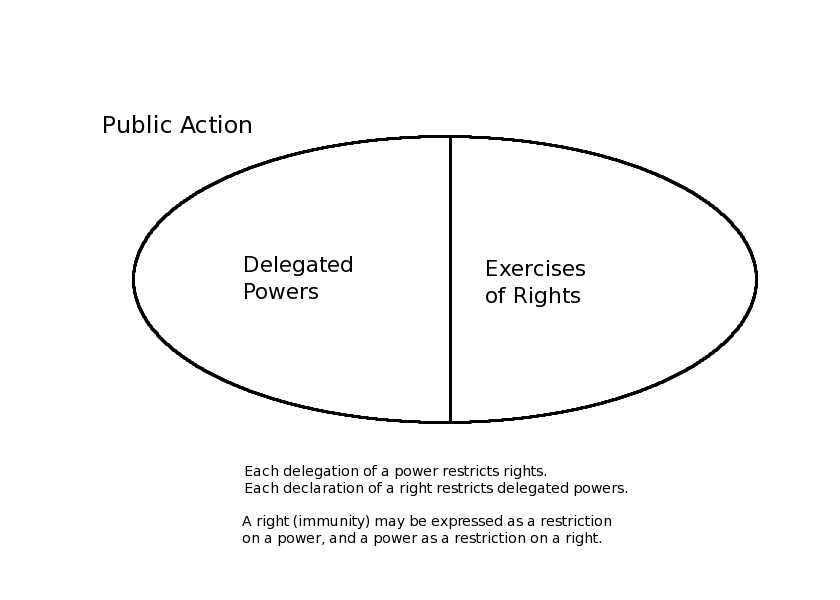

Discussions of rights are sometimes confused concerning what are and are not rights of the people or powers of government or the duties of each. This is an attempt to summarize most of the more important rights, powers, and duties recognized or established in the U.S. Constitution, in Common Law as it existed at the time the U.S. Constitution was adopted, or as implied therein. Not included are certain "internal" or administrative rights and powers that pertain to the various elements of government within each level with respect to each other.
On this site, the term “government” we define as follows:
The above summary is fully recognized by the Declaration of Independence, which says that all JUST powers of government derive from the CONSENT of the governed. Where there is no consent, EVERYTHING government does to you is inherently UNJUST, with the exception of the criminal law itself, of course. THIS is fully consistent with why we say that ALL civil statutory law is law for government ONLY, meaning VOLUNTARY MEMBERS of the “public” only:
Why Statutory Civil Law is Law for Government and Not Private Persons, Form #05.037
https://sedm.org/Forms/05-MemLaw/StatLawGovt.pdf
For PROOF that “United States” is synonymous with “government” or at least “includes” government, see:
PROOF OF FACTS: “United States” INCLUDES (not means) the government, FTSIG
https://ftsig.org/proof-of-facts-united-states-includes-the-government/
LEGAL IGNORANCE about this subject is GUARANTEED to make you a SLAVE of government! GUARANTEED!
“My people are destroyed for lack of knowledge. Because you have rejected knowledge, I also will reject you from being priest for Me; Because you have forgotten the law of your God, I also will forget your children.”
[Hosea 4:6, Bible, NKJV]
This subject is LITERALLY the ROOT of all Third Rail Issues. See:
Third Rail Government Issues, Form #08.032
https://sedm.org/Forms/08-PolicyDocs/ThirdRailIssues.pdf
Avoidance of third rail issues by those in government who are corrupt is summarized in the following scripture:
“For this is the will of God, that by doing good you may put to silence the ignorance of foolish men--16 as free, yet not using liberty as a cloak for [d]vice, but as bondservants of God. 17 Honor all people. Love the brotherhood. Fear God. Honor the king.”
[1 Peter 2:15-17, Bible, NKJV]
All government corruption and unjust political power DEPEND for their entire existence on the fact that you DO NOT know this definition!
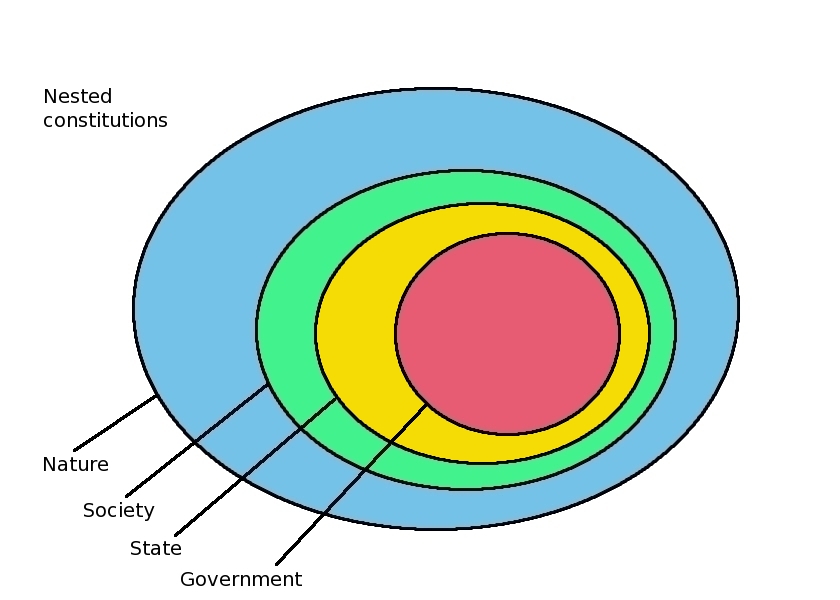
For a description of the symbology we use on this site to describe the various COMPONENTS or CHARACTERISTICS of the term “government” see:
Site Symbology for Political Terms “United States”, “State”, FTSIG
https://ftsig.org/site-symbology-for-political-terms-united-states-state/
The study of how the above various COMPONENTS of “government” relate to government as a whole is called “mereology”:
Wikipedia: Mereology
https://en.wikipedia.org/wiki/Mereology
1. In a state, domicile has EVERYTHING to do with taxation. And domicile is voluntary.
2. Federal is different. Its purely election and not domicile.
3. BUT the constitution doesn’t expressly authorize elections that break down the separation between public and private. The constitutional right to contract, specifically addressed in the Contract Clause (Article I, Section 10, Clause 1 of the U.S. Constitution), prohibits states from passing laws that impair the obligation of contracts. This means states cannot enact laws that alter the terms or enforceability of existing contracts. While the clause protects against state actions, it does not shield contracts from federal laws. HOWEVER, the right to contract or NOT contract is NOT unlimited, because its exercise STILL cannot be permitted to destroy the separation between PUBLIC and PRIVATE or the separation of powers itself.
Government Conspiracy to Destroy the Separation of Powers, Form #05.023
https://sedm.org/Forms/05-MemLaw/SeparationOfPowers.pdf
4. Yes, you can consent to join the government by a formal oath or political election. But to do so:
4.1. Purely by IMPLIED consent by you unilaterally filling out a tax form. OR
4.2. Not having a lawful oath or appointment OR
4.3 A written formal evidence of an acceptance BY THE GOVERNMENT exercised within the delegated authority of the acceptance agent is not authorized.
Produces a DE FACTO government.
The absolute constitutional separation of public and private is sacrosanct. The entire oath of public officers depends on that separation and them protecting it. Here’s a demonstration of that:
All the following activities implement a de facto government:
It’s just a scam and a fraud if they make the requirement for your consent invisible by avoiding the above legal formalities.
“An unconstitutional act is not a law; it confers no rights; it imposes no duties; it affords no protection; it creates no office; it is in legal contemplation as inoperative as though it had never been passed.”
Note: “creates no office”=”U.S. person”
CIVIL STATUS=office.
That SCAM is exhaustively documented in:
De Facto Government Scam, Form #05.043
https://sedm.org/Forms/05-MemLaw/DeFactoGov.pdf
If all just powers originate from CONSENT, and they hide the consent to make it INVISIBLE/IMPLIED so you aren’t aware that they need it to enforce, is ANYTHING JUST beyond that point?
NO!
If EVERYONE received “REASONABLE, UNAMBIGUOUS NOTICE” that being a “U.S. person” was voluntary and forced you to EXPRESSLY rather than IMPLIEDLY volunteer and take a lawful oath, do you think people would continue to elect themselves into this office?
HELL NO!
Ronald Reagan was famous for saying the following:
“The taxpayer: That’s someone who works for the federal government but doesn’t have to take the civil service exam.”
So THAT is the real secret which makes the CONSENT secret.
Can a government established to protect private property and private rights make a profitable business out of alienating ANY of those rights or control over your property in order to pay for the delivery of the protection?
NO!
The FIRST step in protecting PRIVATE property is to keep it from being converted to PUBLIC property by the security guard. If he won’t protect it, why should you hire him with “taxes” to protect you from anyone ELSE?
Like any business, they don’t need to own or control ANY of your property to protect it. Thus, REGISTERING your car or your body with an SSN works a purpose OPPOSITE of government.
Would you hire a security guard to protect your property if the fine print of the contract for his services required him to OWN all the property and simply rent it out to you for a fee called “taxes”.
HELL NO! NO ONE IN THEIR RIGHT MIND would hire a security guard under those terms. Only if the security guard had a MONOPOLY on their services would people even BEGIN to go down that road, and only by force or coercion beyond that point. Thus, the “social compact” is fatally flawed and works a purpose OPPOSITE of establishing government to begin with.
All of these notions are why constitutional rights MUST be inalienable, at least insofar as the relationship between PRIVATE and PUBLIC are concerned. The ONLY geographic place you are even ALLOWED to alienate those rights is where they DON’T apply, which means federal territory or abroad.
If you’re not either abroad or residing on federal territory, every effort to entice you to give up those rights, which are PRIVATE property, transforms the “government” from a PROTECTOR to a PREDATOR!
Of this section some people have asked:
Isn’t all this already on SEDM?
Our answer:
Because if you have to define something, the only way you can prevent equivocation and sophistry by legal predators is to define BOTH what it IS, and what is IS NOT so there is no room for judicial grandstanding to illegally expand definitions by fiat or using presumptions.
"Persons" are one of the two main classes which are the subject of rights, powers, and duties, the other being "citizens". Persons may be "natural" or "corporate". "Citizens" are a subclass of "natural persons". Only persons have standing as parties under due process. Each government has the power to define what is and is not a "person" within its jurisdiction, subject to certain restrictions of Common Law and the Constitution, the 15th Amendment to which requires that it not exclude anyone based on race, color, or previous condition of servitude. Under Common Law existing at the time of the adoption of the U.S. Constitution, "natural personhood" was considered to begin at natural birth and end with the cessation of the heartbeat. But technology has created a new situation, opening the way for statute or court decision to extend this definition and set the conditions under which personhood begins and ends.
Each government may also establish, within its jurisdiction, "corporate persons" such as governmental entities, associations, trusts, corporations, or partnerships, in addition to the Common Law "natural" persons, but the "personhood" of such corporate entities is not created by the government. Its corporate personhood derives from the personhood of its members. Corporate persons must be aggregates of natural persons.
Under Common Law, persons include only individual human beings and combinations of them acting in concert, but it provides a basis for inclusion of entities that are sufficiently like human beings in their behavior to be indistinguishable for legal purposes, such as aliens, androids, or genetically enhanced animals, which have interests, an ability to reason, and an ability to communicate. This would exclude, however, establishment of other things as persons, such as inanimate objects, which have no ability to represent themselves under due process. Inclusion of such inanimate objects as parties to civil due process, in effect making them "persons", has found its way into the U.S. legal system as in rem proceedings, unconstitutionally, through recent seizure/forfeiture statutes.
Although not a well-developed area, there is also a basis for excluding entities which, although they are born to human beings, lack attributes which would enable them to be functionally human, such as some minimal level of cognitive capacity, but such beings must be considered natural persons as the default unless proven otherwise through due process.
Citizenship is the attribute of CIVIL/PUBLIC persons who, as members of the polity as a Private Membership Association (PMA), have certain privileges and duties in addition to those they have as persons. Citizens include those born on U.S. or State territory or naturalized according to law.
The classic definition of "natural rights" are "life, liberty, and property", but these need to be expanded somewhat. They are rights of "personhood", not "citizenship". These rights are not all equally basic, but form a hierarchy of derivation, with those listed later being generally derived from those listed earlier.
|
(1) To enter into contracts, and thereby acquire contractual rights, to secure the means to exercise the above natural rights.[1,15]
(2) To enjoy equally the rights, privileges and protections of personhood as established by law.
(3) To petition an official for redress of grievances and get action thereon in accordance with law, subject to the resources available thereto.
(4) To petition a legislator and get consideration thereof, subject to resources available thereto.
(5) To petition a court for redress of grievances and get a decision thereon, subject to resources available thereto.
(6) Not to have one's natural rights individually disabled except through due process of law, which includes:
(a) In criminal prosecutions:
(1) Not to be charged for a major crime but by indictment by a Grand Jury, except while serving in the military, or while serving in the Militia during time of war or public danger.
(2) Not to be charged more than once for the same offense.
(3) Not to be compelled to testify against oneself.
(4) Not to have excessive bail required.
(5) To be tried by an impartial jury from the state and district in which the events took place.
(6) To have a jury of at least six for a misdemeanor, and at least twelve for a felony.[1]
(7) To a speedy trial.
(8) To a public trial.
(9) To have the assistance of counsel of one's choice.
(10) To be informed of the nature and cause of the accusation.
(11) To be confronted with the witnesses against one.
(12) To have compulsory process for obtaining favorable witnesses.
(13) To have each charge proved beyond a reasonable doubt.[1]
(14) To have a verdict by a unanimous vote of the jury, which shall not be held to account for its verdict.[1]
(15) To have the jury decide on both the facts of the case and the constitutionality, jurisdiction, and applicability of the law.[1]
(16) Upon conviction, to have each disablement separately and explicitly proven as justified and necessary based on the facts and verdict.[1]
(17) To have a sentence which explicitly states all disablements, and is final in that once rendered no further disablements may be imposed for the same offense.[1]
(18) Not to have a cruel or unusual punishment inflicted upon oneself.
(b) In civil cases:
(1) To trial by an impartial jury from the state and district in which the events took place[1] where the issue in question is either a natural right[1] or property worth more than $20.
(2) In taking of one's property for public use, to be given just compensation therefor.
(3) To have compulsory process for obtaining favorable witnesses.[1]
(c) In all cases:
(1) To have process only upon legal persons able to defend themselves, either natural persons or corporate persons that are represented by a natural person as agent, and who are present, competent, and duly notified, except, in cases of disappearance or abandonment, after public notice and a reasonable period of time.[1]
(2) Not to be ordered to give testimony or produce evidence beyond what is necessary to the proper conduct of the process.[1]
(1) To enjoy equally the rights and privileges of citizenship as established by law.
(2) To vote in elections that are conducted fairly and honestly, by secret ballot.
(3) To exercise general police powers to defend the community and enforce the laws, subject to legal orders of higher-ranking officials.[17]
(4) To receive militia training.[7]
See also List of constitutional rights.
Certain of the above rights are restricted, or "disabled", for minors, but the definition of who is a minor and the extent to which each of these rights are disabled for minors, is limited to the jurisdiction over which each government has general legislative authority, which for the U.S. government, is "federal ground" (see below). Minors are the only class of persons whose rights may be disabled without a need to justify the disablement as arising from the need to resolve a conflict with the rights of others, either through statute or due process. The disablement consists of the assignment of a power to supervise the exercise of the rights under the headings of "liberty" and "property" listed above to a guardian, by default the parents, who acts as agent of the State for the purpose of nurturing the minor. The disability is normally removed by statute providing for removal when a certain age, such as 18, or condition, such as marriage, is attained. The disabilities of minority can also be removed earlier by court order or, if statute allows, extended beyond the usual statutory expiration by court order in cases of incompetence. The right to vote is not included among the disabilities of minority, but is defined separately by law, so that removal of the disabilities of minority does not in itself affect having the right to vote.
Constitutional duties of persons under U.S. or State jurisdiction:[7]
(1) To obey laws that are constitutional and applied within their proper jurisdiction and according to their intent.
(2) To comply with the terms of legal contracts to which one is a party.
(3) To tell the truth under oath.
Constitutional duties of citizens under U.S. or State jurisdiction:[7]
(1) To preserve, protect, and defend the Constitution.[6]
(2) To help enforce laws and practices that are constitutional and applied within their proper jurisdiction and according to their intent, and to resist those which are not.
(3) To serve on juries, and to render verdicts according to the constitutionality, jurisdiction, and applicability of statute and common law, and the facts of the case.
Constitutional duties of able-bodied citizens under U.S. or State jurisdiction:[7]
(1) To defend the U.S. or State, individually and through service in the Militia.
(2) To keep and bear arms.[18]
(3) To exercise general police powers to defend the community and enforce the laws, subject to legal orders of higher-ranking officials when present.[17]
(1) Exclusive powers
(1) To lay and collect import duties.[8]
(2) To pay the debts of the U.S. Government.
(3) To regulate commerce with foreign nations and Indian Tribes.
(4) To regulate commerce among the States.[2]
(5) To regulate immigration.[7]
(6) To establish a uniform rule of naturalization.
(7) To establish uniform laws on bankruptcy throughout the United States.
(8) To coin money and regulate its value and that of foreign coin, and to issue bills of credit.
(9) To provide for the punishment of counterfeiting the securities and current coin of the United States.[3]
(10) To fix the standard of weights and measures.
(11) To provide and regulate postal services.
(12) To establish protection for intellectual property, including patent, copyright, and trademark rights.
(13) To constitute lower national courts.
(14) To define and punish piracies and felonies committed on the high seas, and offenses against the laws of nations.[3]
(15) To declare war, authorize warlike activities by other than the armed forces, and make rules concerning captures.
(16) To raise, support and regulate the armed forces.
(17) To govern what part of the Militia shall be employed in the service of the United States.
(18) To exercise general Legislation[9] over federal ground, which is limited to federal territories and districts, land purchased from states with the consent of their legislatures, U.S. flag vessels on the high seas, and the grounds of U.S. embassies abroad.
(19) To guarantee a republican form[12] of government to the States.[3]
(20) To enter into a treaty, alliance, or confederation with a foreign state.
(21) To declare the punishment for treason.[3]
(22) To prescribe the manner in which the acts, records, and judicial proceedings of each state shall be proved to other states and what should be done about them.
(23) To admit new states into the Union.
(24) To dispose of and make all needful Rules and Regulations respecting the Territory or other Property belonging to the United States.
(25) To make laws necessary and proper for executing the powers delegated to the U.S. government.
(2) Pre-emptive but non-exclusive powers
(1) To provide for the common defense and general welfare.
(2) To provide for calling forth the Militia to execute the laws, suppress insurrections, and repel invasions.[16]
(3) To provide for organizing, arming, and disciplining the Militia.
(4) To prescribe the times, places and manner of holding elections for members of Congress, except the places for electing senators.
(5) To conduct a census every ten years.
(3) Non-pre-emptive non-exclusive powers
(1) To lay and collect excise taxes on commerce or income taxes on persons.[8]
(2) To borrow money.
(1) No exercise of powers not delegated to it by the Constitution.
(2) No payment from the Treasury except under appropriations made by law.
(3) Excises and duties must be uniform throughout the United States.
(4) Shall pass no tax or duty on articles exported from any state.[5]
(5) No appointment of a senator or representative to any civil office which was created while he was a member of Congress or for which the amount of compensation was increased during that period.
(6) No preferences to the ports of one state over another in regulation or tax collection.
(7) No titles of nobility shall be granted by the U.S. government, or permitted to be granted to government officials by foreign states.
(8) May not protect a State against domestic violence without the request of its legislature, unless it cannot be convened, in which case, without the consent of its executive.
(9) U.S. courts do not have jurisdiction over suits against a state by citizens of another state or foreign country.
(1) Exclusive powers
(1) To appoint persons to fill vacancies in the U.S. Congress from that state and to hold special elections to replace them. State executive may make temporary appointments if state legislature in recess and until they reconvene, when they shall appoint a temporary replacement.
(2) To appoint the officers of its Militia.[11]
(3) To conduct the training of its Militia.[12]
(2) Non-exclusive powers[4]
(1) To prescribe the times, places and manner of holding elections for members of Congress.[10]
(1) State constitutions and laws may not conflict with any provision of the U.S. Constitution or U.S. laws pursuant to it.[7]
(2) May not exercise powers not delegated to the State government by the State Constitution.[7]
(3) May not make anything but gold or silver coin a tender in payment of debts.
(4) May not pass a law impairing the obligation of contracts.
(5) May not grant a title of nobility.
(6) May not collect imposts or duties on imports or exports without consent of Congress, except fees necessary to cover the costs of inspections and paid to the U.S. Treasury.[8]
(7) May not lay a duty on tonnage.
(8) May not keep troops or ships of war in time of peace or make war without the consent of Congress, unless actually invaded and in imminent danger that does not admit of delay.
(9) May not make a compact or agreement with another state of the U.S. or with a foreign state without the consent of Congress.
(1) Must provide a republican form[12] of government to their citizens.[7]
(2) Must conduct honest and fair elections, by secret ballot.[7]
(3) Must give full faith and credit to the public acts, records, and judicial proceedings of every other state, and recognize the privileges and immunities granted thereby.
(4) Must extradict a person charged with a crime in another state to that state.
(5) Must organize and train their militias.[7]
(1) Shall not disable any natural or constitutional right without due process of law, and then only to the extent necessary to avoid infringing the rights of others.
(2) Shall not deny any person within its jurisdiction equal protection of the laws.
(3) Shall not suspend habeas corpus, except in case of rebellion of invasion and the public safety may require it.
(4) Shall not issue a search warrant but on probably cause, supported by an oath or affirmation, and particularly describing the place to be searched, and the person or things to be seized.
(5) Shall not arrest members of Congress, except for treason, felony, or breach of the peace, while their house is in session.
(6) Shall not question a member of Congress on anything he says during a speech or debate in his house.
(7) Shall not pass any bill of attainder or ex post facto law.
(8) Shall allow no slavery or involuntary servitude except as punishment for a crime of which the party shall have been duly convicted.
(9) Shall not deny or abridge the right to vote to any person on account of race, color, previous condition of servitude, sex, for failure to pay any tax, or on account of age if older than 18.
(10) Shall not exercise any power in an unreasonable manner or for other than a legitimate public purpose, as partially indicated in the Preamble. (No power is "plenary", and discretion can be abused.)
(1) To regulate the manufacture, distribution, operation, and disposition of aircraft and spacecraft, the regulation of their crews, and the definition and punishment of crimes committed on U.S. registered aircraft or spacecraft or on aircraft or spacecraft operating in U.S. airspace.
(2) To regulate cabled or wireless communications beyond a distance of 1 kilometer.
(3) To regulate the production, distribution, and use of nuclear energy, and electric energy transmitted more than 1 kilometer.
(4) To limit tort liability on commerce and commercial articles subject to U.S. regulation of their manufacture.
(5) To pre-emptively pass and enforce laws needed to conserve wildlife and natural resources, to protect the climate and natural environment, to prevent an excess of population, and to regulate public health and workplace safety.
(6) To provide for the punishment of abuses of power by any official, agent, or employee of, or contractor for, any institution of government, and specifically any violations of the Constitution and laws pursuant thereto.
(7) To provide for the punishment of abuses of the natural rights of persons by other persons, in the event that those abuses, if the occurred on state ground, are not prosecuted by a State government.
(8) To define "due process" to include the elements given above which are not now explicit in the U.S. Constitution.
(9) To define the arms to which persons have a right to keep and bear as including "all those weapons which may be carried by one person and which might be useful or necessary to defend oneself or the community, except weapons of mass destruction such as bombs, heavy missiles or artillery, or biological, chemical, or nuclear agents which may cause lasting injury or death."
(10) To make explicit that only natural persons or corporate persons composed of natural persons may be the subject of due process in any civil or criminal proceeding.
[1] This is established in Common Law at the time the U.S. Constitution was adopted, but is not explicit in the U.S. Constitution.
[2] Originally, "commerce" meant only transfers of goods or services for a valuable consideration, so that "interstate" commerce would not include interstate migration, carrying across a state border of one's own possessions that one intends to keep, the sending across a state border of a gift or inheritance, nor include articles which had not yet crossed a state border, or articles which had "come to rest" with the completion of the transfer. It would not include manufacturing, local sales, or things that are "part of an aggregate" of interstate commerce, or things that might "affect" interstate commerce. Note also that the power to regulate does not include the power to criminally prosecute violations of regulations, but only to seize property through civil process.
[3] These are the only provisions that allow federal criminal laws jurisdiction outside federal ground.
[4] These powers, if not exercised by the State, revert to the people.
[5] This provision would seem to forbid taxes on interstate commerce if export to another state of the U.S. is included, leaving only intrastate commerce or commerce on federal ground subject to excise taxes or duties, although interstate commerce can otherwise be regulated.
[6] This means obeying constitutional laws and practices, and resisting unconstitutional ones.
[7] This is not clearly stated, but implied.
[8] The power to tax is not the power to regulate or license, and vice versa. That is why the powers to tax and to regulate are separately specified. With one exception, which is never used (in Art. 1 Sec. 10), no allowance is made for the charging of fees to cover the costs of regulation, even though this has become a common practice, in violation of the Constitution.
[9] This use of the word "Legislation" is a term of art which grants general powers within its jurisdiction, including powers of criminal and civil law that a State might exercise within its jurisdiction, but unlike a State in that a State would be restricted by a state constitution granting it only certain powers. This is a major gap in the Constitution. Although it applies only to federal ground, it also does not make clear what are the limitations on such legislative power, other than the natural and constitutional rights of persons, and so has been interpreted to allow anything that does not violate those rights. There is a need for a federal sub-constitution, similar to a typical state constitution, that applies to federal ground.
[10] The wording suggests that the States have the power, but allows the Congress to pre-empt it.
[11] But this implies that if the State fails to appoint such officers, local militias are left to elect their own, which was the established Common Law practice at the time the U.S. Constitution was adopted. But "according to the discipline prescribed by Congress". This means Congress can direct, but not forbid it, and implies that, in the absence of any training conducted by the State, local militias are left to organize and train themselves, which was the established Common Law practice established at the time the U.S. Constitution was adopted.
[12] The term used is "form" of government, but the Framers seem to have meant substance as well, and that is reasonably implied.
[13] The original term was "well-regulated", but this is what was meant. Militias were originally local and independent of official authority, and it was intended that although they be subject to official authority when called into service by such authority, that they also be able to convene and operate independently when not.
[14] "Vehicle" was not explicitly included, but implied as an "effect".
[15] This is needed to allow persons not only to have rights but the means to exercise them, and also to acquire those means if they do not already have them, without which the right would be unduly burdened. However, beyond this right, the community has the general power to restrict contracts for reasons of public policy and not just to avoid conflicts with the rights of others, so that there is not a general "right" of contract, but a "default privilege" of doing so, subject to law, for contracts that do not involve securing the means to exercise their natural rights.
[16] This is worded as "to execute the Laws of the Union", thus allowing States to also call forth their Militias to execute their own laws.
[17] The exercise of general police powers is both a right of citizens, and a duty of able-bodied ones. All citizens are policemen, although ordinary citizens may be outranked by professional police officers when such officers are present in a law enforcement situation.
[18] Likewise, the keeping and bearing of arms, while a right of persons, is also a duty of able-bodied citizens.
Note that there is no right to marry or bear children included among any of the rights listed above. It is not a "natural" right, because natural rights are only rights of individuals, and exercise of a "right" to marry, without the consent of the other, would be an assault. Since consent is required, it is a matter of contract, and contractual rights are created by the community, even if it is a "community" of only two persons. Since the community is normally a larger polity, and since all legal contracts are agreements not only between the contracting parties, but also with the entire community, therefore the community has the power to regulate marriage and childbirth, and has exercised that power since time immemorial, for the benefit of the community.
Note also that the fundamental unit of the social contract is the local community, ward, or village. These may aggregate into a larger "state" or "federal union", but the basis is agreement among those who are in direct contact with one another.
It is sometimes thought that "the Constitution" consists only of the written document. This is not so. The title "The Constitution of the United States" was added after the document was adopted, but "constitution" meant the "basic legal order", and the Constitution consists of both the written document and the common law at the time the document was adopted, which is here referred to as the Common Law in caps. Now, the written document does supersede the Common Law where they might be in conflict, but it does not replace it, and courts must refer to the Common Law for guidance where the written document is silent or ambiguous.
In addition to the written document and the Common Law, the Constitution also includes Treaties, which, although they are valid only insofar as they are not in conflict with the written Constitution, are superior to both the Common Law and to State constitutions and laws, to the extent that those might be in conflict with the Treaties. Thus, some of the Treaties that have been adopted extend and clarify some of the rights, powers, and duties provided in the written Constitution. For example, that is how "federal ground" is extended to include coastal waters out to a certain distance from shore, and the grounds of U.S. embassies abroad, and how the rights of the people are amplified by the Charter of the United Nations and by various bilateral and multilateral Treaties that extend civil and commercial rights to U.S. citizens abroad.
The following diagrams can help clarify the relationship among the various elements of law in the U.S. legal system. Each element is superior to the one below it, although state constitutions are derived from their people, not from the U.S. Constitution. Although not shown, each element also includes the body of writings and recorded speeches of the legislators, diplomats, and judges who wrote the constitutions, treaties, laws, and court decisions, which clarify their intent, and which must be accepted as the basis of interpreting the words as originally meant and understood when there is confusion or dispute over their meaning.
| Constitution Research | |
| Last revision: 20250625 | |