“The privileged man, whether he be privileged politically or economically, is a man depraved in intellect and heart.” "... freedom of men under government is to have a standing
rule to live by, common to every one of that society, and
made by the legislative power erected in it. A liberty to
follow my own will in all things where that rule prescribes
not, not to be subject to the inconstant, uncertain,
unknown, arbitrary will of another man, ..." |
The main purpose of establishing government is to protect PRIVATE property and PRIVATE rights. That protection is implemented mainly by maintaining an absolute separation between PUBLIC and PRIVATE property at all times as described below:
Separation Between Public and Private Course, Form #12.012
https://sedm.org/LibertyU/SeparatingPublicPrivate.pdf
The Constitution is the origin of private property and private rights which under franchise law are sometimes called "common rights". Its creator and grantor is WE THE PEOPLE, who are PRIVATE. It represents the absolute rights of PRIVATE/CONSTITUTIONAL "persons" in the absense of any act of POLITICAL or CIVIL legal association. Any attempt to pursue membership then results in a SURRENDER of some portion of said PRIVATE rights in exchange for PUBLIC revocable privileges under the Constitutional Avoidance Doctrine and the Public Rights Doctrine of the U.S. Supreme Court:
“When one becomes a member of society, he necessarily parts with some rights or privileges which, as an individual not affected by his relations to others, he might retain. “A body politic,” as aptly defined in the preamble of the Constitution of Massachusetts, “is a social compact by which the whole people covenants with each citizen, and each citizen with the whole people, that all shall be governed by certain laws for the common good.” This does not confer power upon the whole people to control rights which are purely and exclusively private, Thorpe v. R. & B. Railroad Co., 27 Vt. 143; but it does authorize the establishment of laws requiring each citizen to so conduct himself, and so use his own property, as not unnecessarily to injure another. This is the very essence of government, and 125*125 has found expression in the maxim sic utere tuo ut alienum non lædas. From this source come the police powers, which, as was said by Mr. Chief Justice Taney in the License Cases, 5 How. 583, “are nothing more or less than the powers of government inherent in every sovereignty, . . . that is to say, . . . the power to govern men and things.”
[Munn v. Illinois, 94 U.S. 113 (1877); SOURCE: https://scholar.google.com/scholar_case?case=6419197193322400931]
Note from the "membership" mentioned above is implemented exclusively with the civil statutory law and NOT the Constitution. The civil statutory law functions as a Private Membership Association (PMA) in effect. That civil statutory law, as the above implies, is a social compact that only pertains to CONSENTING CIVIL members of the body politic who legally associate by choosing a civil domicile within the civil jurisdiction of the group. Those members so associated then become members of the COLLECTIVE and CIVIL agents of the state when serving in a political capacity, such as when voting or serving as a jurist or even when being a statutory "taxpayer".
Why Statutory Civil Law is Law for Government and Not Private Persons, Form #05.037
https://sedm.org/Forms/05-MemLaw/StatLawGovt.pdf
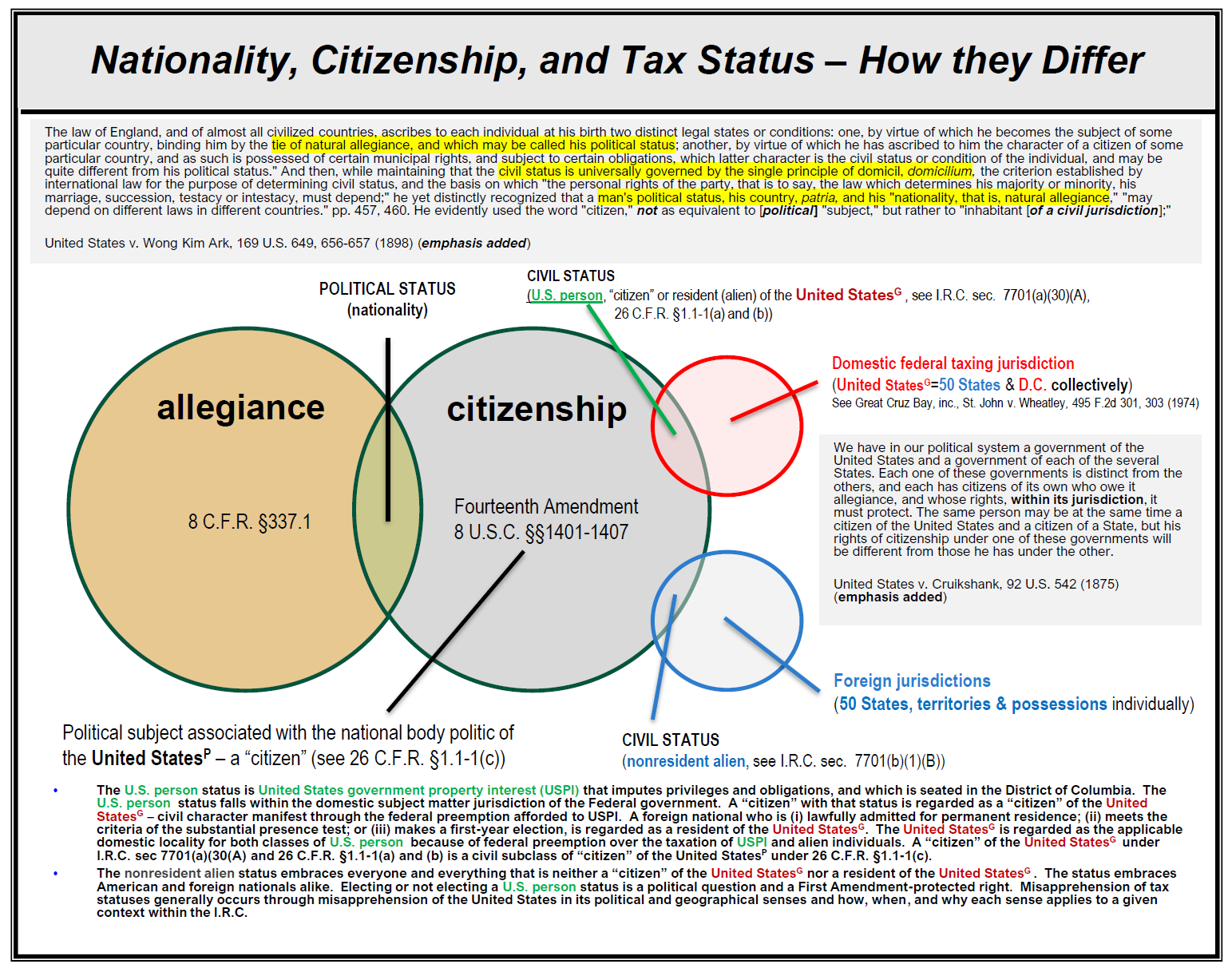
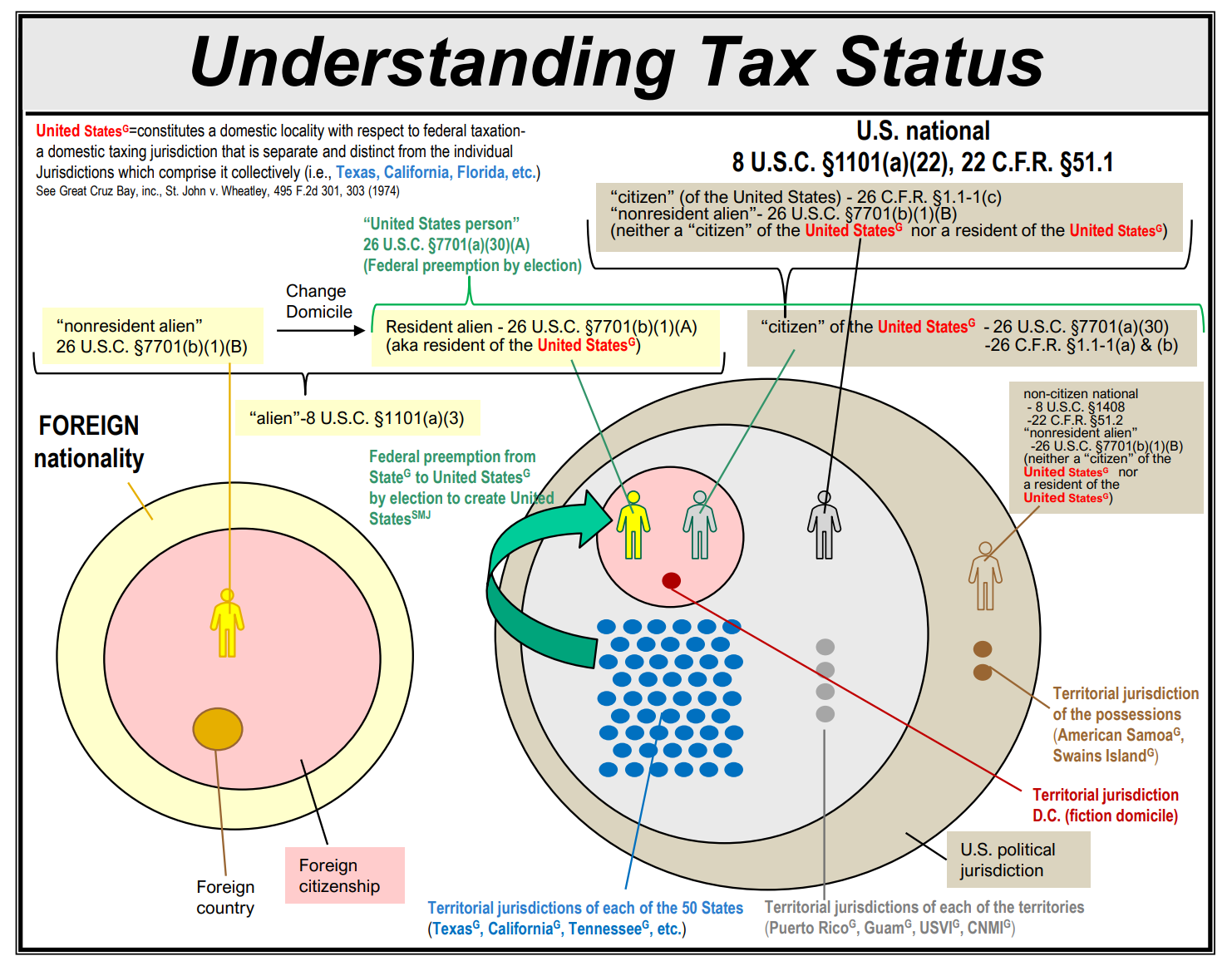
An act of birth is not an act of consent. You can't CHOOSE to be born. Thus, political status resulting from birth or naturalization is not, in itself, a privilege or considered consentual or revocable after it is obtained. To become a CIVIL member, a voluntary domicile must be ADDED to one's political status as a POLITICAL "citizen" to become a CIVIL "citizen". Those who never exercise their First Amendment right to consensually legally/civilyassociate are called "nonresidents" and "transient foreigners" and are instead governed by the common law and not the civil law. They are described in:
Corrupt government prosecutors and agents will often maliciously try to blur the lines between POLITICAL membership and CIVIL membership in order to unlawfully enlarge their otherwise very limitied CIVIL jurisdiction as follows:
Below is a diagram of how political status, civil status, and membership is reflected in both the constitution and the civil statutory law.


 Social
Contract and Constitutional Republics, Jon Roland, 1994,
with 2007 Supplement. Constitutional History &
Commentary Collection — Books, anthologies, and essays. On
Liberty, John Stuart Mill (1860) — Carries social
contract theory beyond Locke. Second
Treatise on Government, John Locke (1689) —
Principal proponent of the social contract theory which forms
the basis for modern constitutional republican government.
Social
Contract and Constitutional Republics, Jon Roland, 1994,
with 2007 Supplement. Constitutional History &
Commentary Collection — Books, anthologies, and essays. On
Liberty, John Stuart Mill (1860) — Carries social
contract theory beyond Locke. Second
Treatise on Government, John Locke (1689) —
Principal proponent of the social contract theory which forms
the basis for modern constitutional republican government.  The
Paradox of Self-Amendment: A Study of Law, Logic,
Omnipotence, and Change, by Peter Suber, Philosophy Department,
Earlham College. Explores logical problems with constitutions,
especially involving amendment of them.
The
Paradox of Self-Amendment: A Study of Law, Logic,
Omnipotence, and Change, by Peter Suber, Philosophy Department,
Earlham College. Explores logical problems with constitutions,
especially involving amendment of them. | Nullum ius sine summo legislatore. There is no law without a sovereign (supreme lawgiver). — Ancient legal maxim. |
The Law, Frederick
Bastiat (1850) — Classic treatment of one of the main challenges
to the survival of democratic government. Politics, Aristotle
(~350 BCE) — Laid out the alternative forms of government. Discourses
on Livy, Niccolo Machiavelli (1517) — Argues for the
ideal form of government being a republic based on popular
consent, defended by militia. Representative
Government, John Stuart Mill (1861) — Carries the
theory of constitutional republican government beyond the
Framers of the U.S. Constitution. Selected
Works on Tyranny — To understand the principles of
constitutional republican government, one must understand the
principles of its opposite. Selected
Works of Herbert Spencer (1802-1903) — Early libertarian
political philosopher. Selected Works, Harvey
Wheeler — Papers on Francis Bacon and constitutional history and
law. De
Cive (The Citizen), Thomas Hobbes (1641-47) — Laid
basis for social contract theory, providing branching point for
the theories of constitutionalism and fascism. Address before the Young
Men's Lyceum of Springfield, Illinois, Abraham
Lincoln (1838) — Presents the idea of a political religion.| Never ascribe to malice that which is adequately explained
by incompetence. — Napoleon Bonaparte |
Law and Government Topic, Family Guardian Polybius
and the Founding Fathers: the separation of powers, by
Marshall Davies Lloyd — Analysis of how we got the idea of
separating legislative, executive, and judicial functions into
different branches of government. Institutes of Oratory,
Quintilian, 95 CE, tr. John Watson, 1856. A leading rhetorician
of the Cicero school wrote this 12-volume treatise,
that continues where Aristotle left off, and represents the
highest standards of Roman virtue. Volume 1 Volume 2 On the
Laws and Customs of England, Henry de Bracton (1268)
— First codification of English common Law. Summa
Theologica, St. Thomas Aquinas (1225-74) — Develops
doctrine of righteous government according to Christian
principles, based in part on earlier work of St. Augustine,
written 1265-73. Dialogus,
William of Ockham (1280-1349) — This medieval English political
philosopher laid the basis for the early theory of law,
especially on property and the law of nations, that led to
Common Law. In Latin, being translated into English, under
construction. Noted for the Principle of Parsimony, also
known as Ockham's Razor: "Entia non sunt
multiplicanda praeter necessitatum" — "Do not multiply
entities beyond necessity", or in other words, "When in doubt,
do without." In the theory of knowledge, it means that among
theories that equally explain the facts, always choose the
simplest. Summary Second Part: Magna Carta The English Works of Thomas Hobbes of Malmesbury An
Inquiry into the Nature And Causes of the Wealth of Nations,
Adam Smith (1776) — Classical economics that shaped the writing
of the U.S. Constitution. John
Stuart Mill — Econlibrary summary On
Democracy in America, Alexis de Toqueville (1835,
1840) — Discusses the society that makes republican government
work and how it is shaped by that form of government. Disquisition
on Government, John C. Calhoun — Discussed the
problem of defending the rights of a minority against a
persistent majority. The
Structure of Liberty, Randy E. Barnett — Excerpts
from a libertarian approach to law. Contemporary
Approaches to the Social Contract, Entry from online Stanford
Encyclopedia of Philosophy. Liberalism,
by Ludwig Von Mises. Critique of the dominant political faction
in the modern world. Natural
Law and Natural Rights, by James A. Donald. Historical
review of the concepts. Why
Freedom? — Debate on social contract theory between Tibor
Machan and Jan Narveson at the Independent Institute Conference
Center, March 31, 1999. Works of George Orwell —
Includes 1984
and Animal
Farm. Baruch Spinoza — Stanford Encyclopedia of Philosophy The
Secret Team: The CIA and Its Allies in Control of the United
States and the World, by L. Fletcher Prouty (1997). Forgotten
Founders: Benjamin Franklin, the Iroquois and the
Rationale for the American Revolution, by Bruce E. Johansen. Rupert
Sheldrake — Scientific fields are too often captured by
orthodoxy and dogmatism. Heterodox
Academy — Promote open inquiry, viewpoint diversity, and
constructive disagreement. The Proceedings of the Friesian
School — Collection of academic papers, dedicated to the
philosopher Lysander
Spooner Collection — American political philosopher.| For every complex problem, there is a solution that is
simple, neat, and wrong. — H. L. Mencken |
| For every problem there is a solution which is simple,
obvious, and wrong." — Albert Einstein |
Prisoner's
Dilemma and Public Choice Theory — Explorations of the
conflict between what is rational for the individual and what is
rational for the group. Behavioral
Economics — Explores the psychological and cognitive
factors in economic decisions.  Counterintuitive
Behavior of Social Systems, by Jay Forrester — Classic
paper on why public policies produce unintended consequences. Evolving
Complex Networks in Constitutional Republics, by Jon
Roland — Examines how changing network structures can reveal how
political and economic processes behave and misbehave. Chaos and Constitutions, by
Jon Roland — Examines how the behavior of societies can only be
managed in small ways and without reliable outcomes.
Counterintuitive
Behavior of Social Systems, by Jay Forrester — Classic
paper on why public policies produce unintended consequences. Evolving
Complex Networks in Constitutional Republics, by Jon
Roland — Examines how changing network structures can reveal how
political and economic processes behave and misbehave. Chaos and Constitutions, by
Jon Roland — Examines how the behavior of societies can only be
managed in small ways and without reliable outcomes. Metagaming
for Constitutional Design — Toward constitution-writing
programs that may generate better constitutions than conventions
of human beings can design.
Metagaming
for Constitutional Design — Toward constitution-writing
programs that may generate better constitutions than conventions
of human beings can design.| Click on the button to get the indicated file format: | |||||||
|---|---|---|---|---|---|---|---|
| Format | HTML | Text | WP | RTF | Word | Image | |
| Local | |
|
 |
|
 |
|
 |
| Remote | |
 |
 |
 |
 |
 |
 |
| Constitution Research | |
Last revision: 20250625 |
|